Norse analogue · Wave-maiden
Bylgja
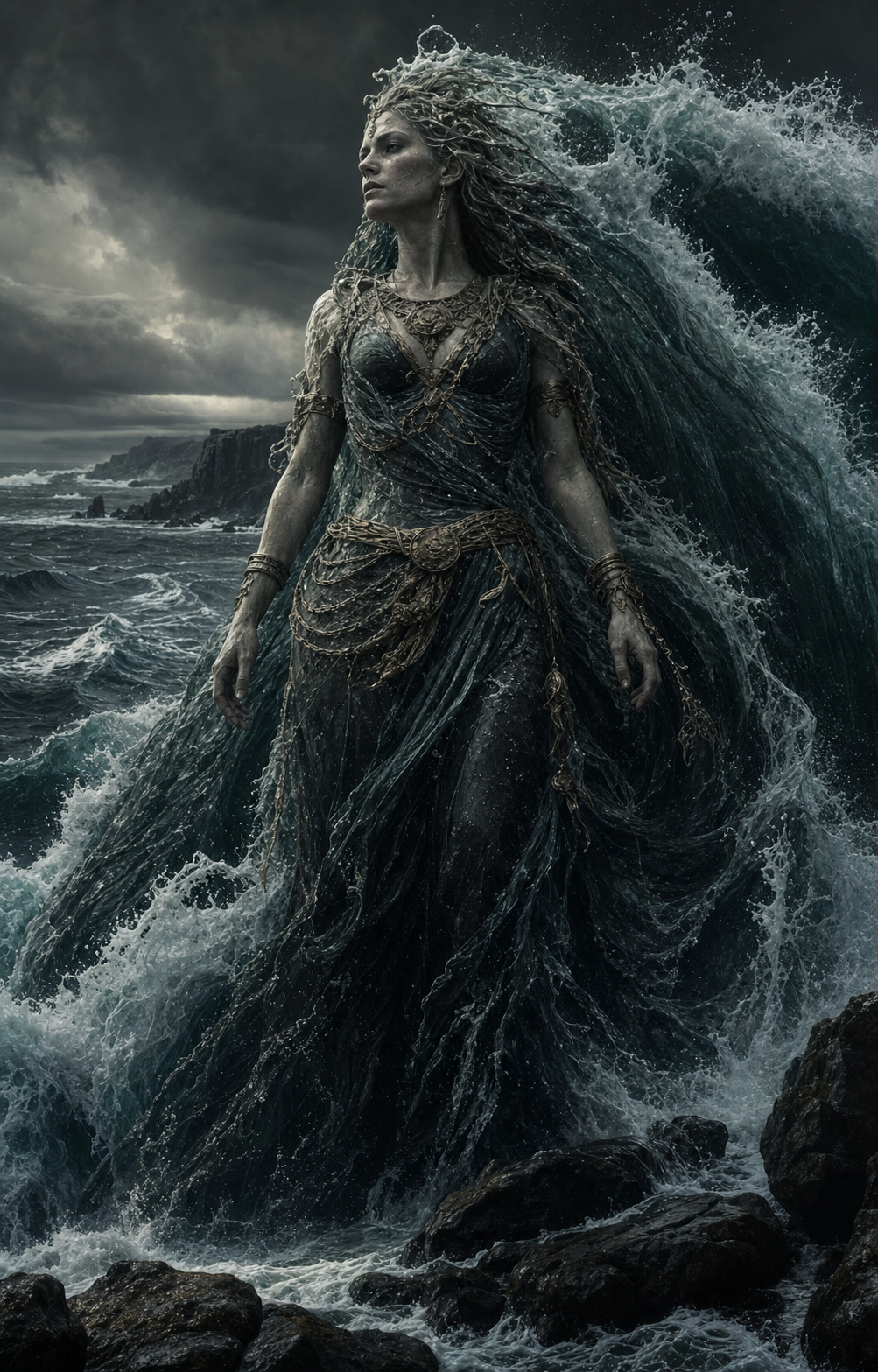
Bylgja is one of the wave-maidens, daughters of Aegir and Ran, whose name is commonly understood as "billow." She is less a character with a surviving plot than a named force of the sea — the moment water lifts, crests, and threatens to break.
Story shape
A living surge, kin to storm and tide
The wave-maidens appear in Old Norse poetic tradition as personified waters: daughters of the sea-host Aegir and the net-bearing Ran. They are listed in skaldic verse alongside their siblings — Kolga, Hefring, Udr, and others — each name pinning a different motion of the ocean to a human form.
Bylgja gives a face to the instant a wave gathers height. Her identity is inseparable from a specific natural motion: the swell before the crash, the body of water leaning toward shore. In the hall of Aegir she is kin, a daughter at the feast table; on the open sea she is weather made visible, one of nine sisters who together describe the full grammar of northern water.
Unlike Greek nymphs with elaborate pursuit narratives, Bylgja survives chiefly as atmosphere and nomenclature. That spareness is not a weakness. It is how Old Norse myth often works: naming the force is the first act of respect, and the name itself becomes a kind of story.
She opens a northern grammar of nature-spirit: not a classical nymph in sandals, but a named presence inside water, kinship, danger, and weather.
For Nymphine, Bylgja establishes the terms of the northern section. These figures are not imported into Greek categories; they arrive on their own logic, as daughters of a household that is also a storm. To read her is to learn how skalds thought about the sea — not as empty expanse, but as a family of moods you could address, fear, and feast with.
Tradition boundary
Old Norse sources do not have a direct equivalent to the classical Greek nymph. The northern figures gathered here are wave-maidens, forest beings, and nature spirits whose lives are bound to water, weather, and hidden land.